
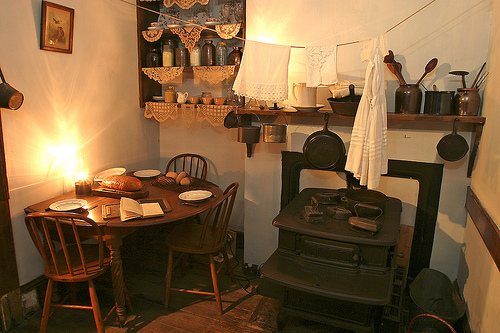
After the Essex Street Market, we walked a few blocks to the Tenement Museum, where we were given a tour that focused on the life of the Moore family. This museum was founded in 1988, and was once a tenement. This museum's focus is to preserve the heritage and honor the millions of immigrants of the Lower Eastside (BG p.122). The museum is a six-story Italianate brownstone that houses five apartments. It has been restored to its 19th century appearance in order to recreate the Moore family's experience (BG p.122). During the tour, we were first shown pictures of what the neighborhood was like. Streets were filled with mountains of garbage. We had also seen pictures of everyday life and how women would be crowded and doing laundry together and maybe gossiping or catching up. We had learned of the difficult life that many immigrants such as the Moore family had to deal with. For example, one story that our tour guide told us was the hardships in trying to find a job. Many of these immigrants came to America for a better life, however, once arriving here, they were discriminated and denied of any jobs. The inability to find a job, therefore made it very difficult for families to get by. For example, the Moore family's youngest child, who was only a few months old, became sick because of the milk that was being fed to her. Milk back then was not pasteurized and even contained chalk to make it the color white. The Tenement Museum was probably my favorite part of the day. It was not just a regular museum where you look at artifacts behind a glass or in a frame. When walking into the rooms, you were able to take in the room and be able to almost live and experience what the Moore family was experiencing. I highly recommend this museum to anyone. The tour guide was very informative as well and made the tour very interesting and fun.

We then headed to Orchard Street, where we had learned that it was the center of the Jewish community. Orchard Street was named after the apple orchards on the 18th century farm of James De Lancey (BG p.120). It is considered the district's main shopping street, where many people can haggle and shop over handbags or home decorating fabrics. Our tour guide showed us a picture of Orchard Street and how it was back then. The picture showed a street that had mountains of garbage and horse feces, and when it snowed, snow would be on the bottom, covered up by the garbage and feces. We had also learned that during that time, there were no greenspace, it was in the streets where children played and gathered. Our tour guide also told us about Seward Park High School, which was an immigrant school, that consisted of 1% white and 99% non-white. At the time, there were also garment factories, where women worked in sweatshops. It is very hard to believe that where we were standing, this place once existed. Now, this place is even showing signs of gentrification where art galleries are starting to appear.
We then headed to Hester Street, which was a place that had rows and rows of tenements and no park. Hester Street also once had a push cart market that stretched a few blocks north and south. We had also learned about Jacob Riis, a reformer who during the Progressive era pushed for parks. He believed that we should use the city to provide amenities. The first municipal playground was therefore created. It had however become the ghetto and the slum when peddlers would sell stuff. Before the 1930's, peddlers did not need to have a permit to sell things, however this was changed due to health code violations. We also visited the Independent Kletzer Aide Association, which was used to help out immigrants in Kletz. This was an example of how Eastern European Jews would be scattered throughout Immigrant NY and how different towns from different countries would come together in NY.


After learning a bit about Canal Street, we headed to Chinatown where we had learned that it has been expanding in the last 30-40 years. Chinatown was also considered a center for illegal immigration, where people from China would be smuggled through boats to arrive in Latin America and then the U.S. An agency would then find the person a job. We had also learned that since it cost a lot of money to get smuggled to the U.S., some people didn't have enough money to pay the agency when they arrived and therefore had to make payments to them and were indebted to them. Chinese immigrants were also able to travel throughout the country. This was made possible by the Transcontinental Railroad, which was completed in 1869. Peasant laborers in the West who were brought to build the railroad, were faced with racial hostilities and would travel eastward (BG p.108). Racial hostilities and discrimination towards Chinese people erupted even more with the Chinese Exclusion Act which lasted 61 years from 1882-1940. This ended because Chinese became an ally of the U.S. during World War II. We then headed to the Eldridge Street Synagogue, considered a landmark because it is the oldest Eastern European Jewish synagogue. It was designed by 2 German architects. It was considered the grandest synagogue on the Lower East Side, drawing in many worshipers during the high Holy Days. Police were even sometimes called to control the crowds (BG p. 120). We then headed to Yung Wing School, which was connected to a Plaza. We had learned that Yung Wing was the first Chinese person to get a college degree in Yale University. He converted to Christianity and was responsible for building Western schools in China.


We then headed to Doyers Street. Dowyer, Pell, and Mott Street, we had learned are considered the oldest streets. Doyers Street was once known as "Bloody Angle". This was due to the crooked, narrow streets that would hold sword fight games against two powerful families, the Hip Sings and On Leongs (BG p.112). We then visited the Church of Transfiguration, which was once a Zion Episcopal Church, but is now a Roman Catholic parish that hold their masses in Cantonese, Mandarin, and English (BG p.112). We had also learned about Five Points and how it was the center of prime poverty, especially for the Irish and African Americans who lived there. This was due to the hardships in trying to find a job.


We then ended out day in Little Italy. Little Italy today has now become a tourist spot, where it is attracting visitors to its Italian restaurants (BG p.114). It was here where we said our bittersweet farewells and headed for some cannolis at Ferrara Bakery and Cafe.


No comments:
Post a Comment